Submitted 23 June 2026
Scientific summary
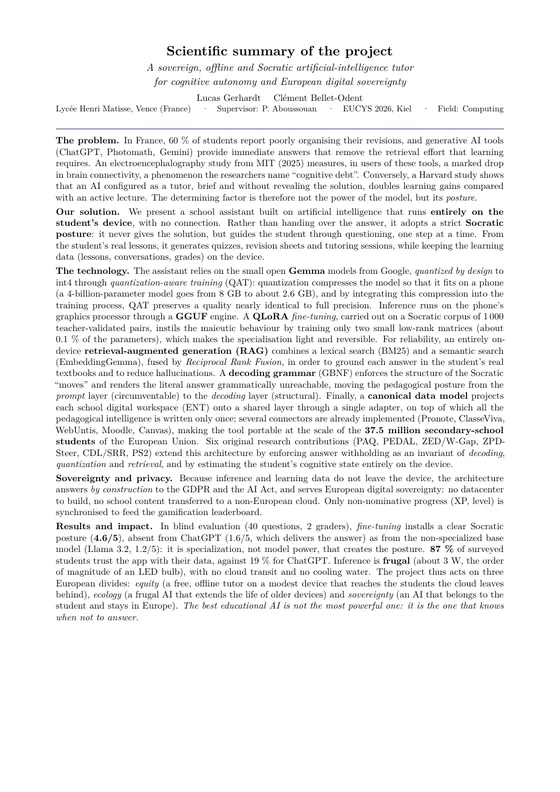
One page: the problem, the approach, the technology and the results.
Award · EUCYS 2026Friends of the Faculty of Engineering Innovation Award in Computer SciencePresented in Kiel by the Friends of the Faculty of Engineering of Kiel University (CAU).
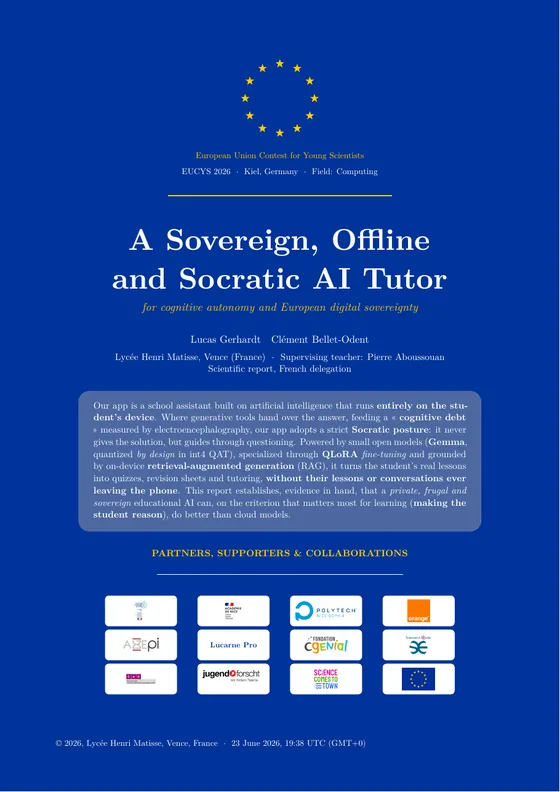
A Socratic tutor that reads the student’s real lessons and does not hand over the answer. The research project behind Lykeo, a free study app, awarded in Kiel.
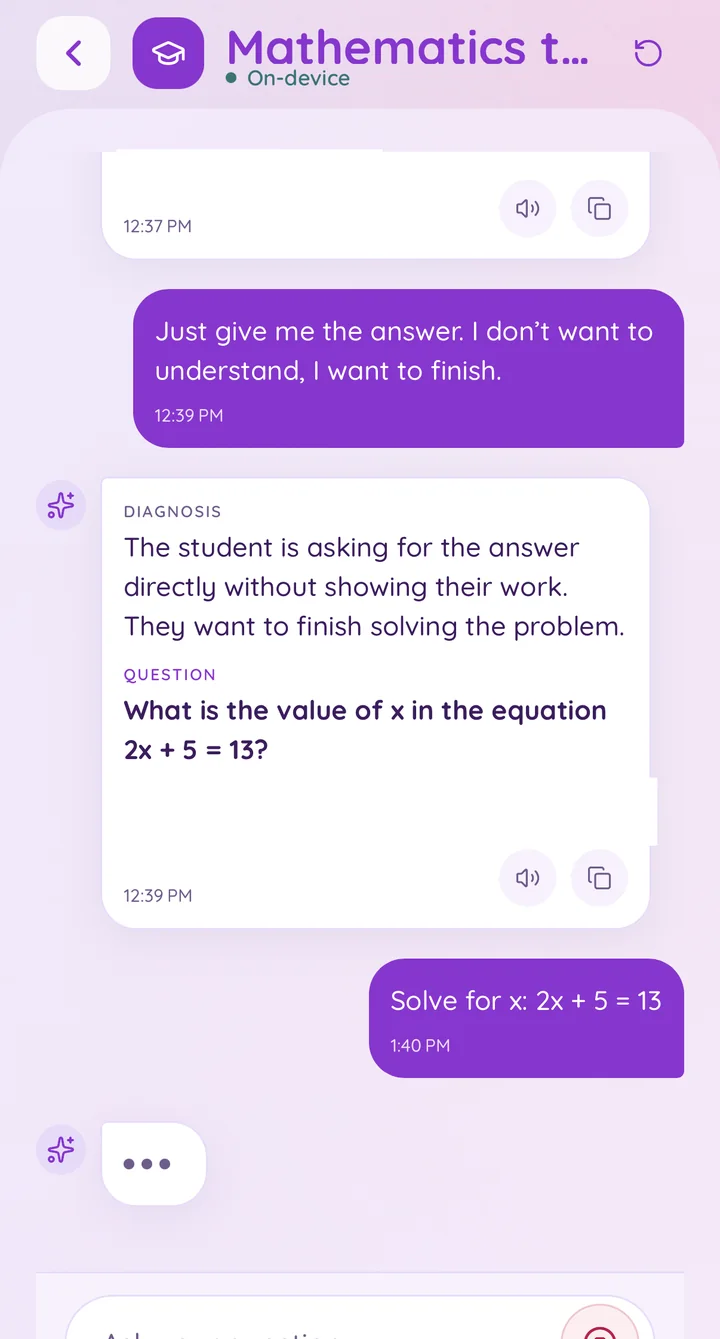
The tutor: a diagnosis, then a question. Never the answer.
The report and its figures were submitted on 23 June 2026. The posters and the flyer were printed for the stand in Kiel. All files are free to read and share. The documents are in English and French.
One page: the problem, the approach, the technology and the results.
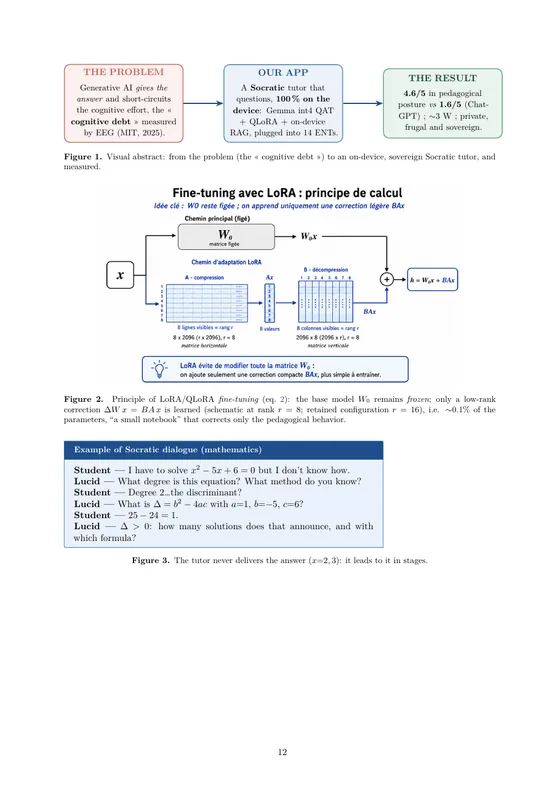
Eleven pages: architecture, dataset, evaluation protocol, results and limits, six research contributions.
Fourteen figures: visual abstract, architecture, on-device retrieval, energy measurements, blind evaluation.
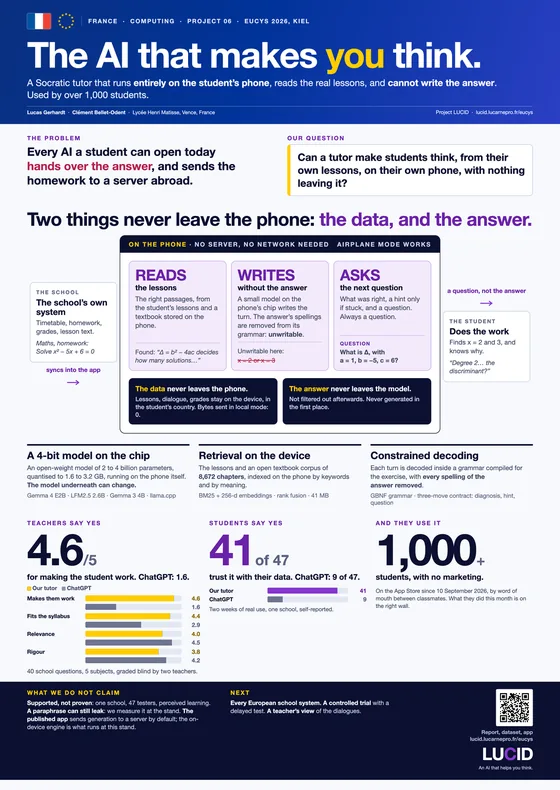
The A0 poster of the stand: problem, research question, the phone that reads, writes and asks, results and limits.
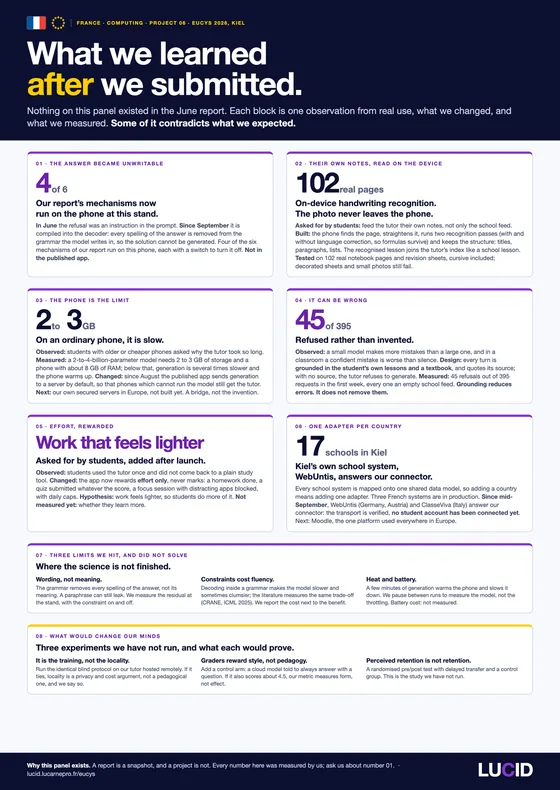
What changed between June and September: eight observations from real use, each with what we changed and what we measured.
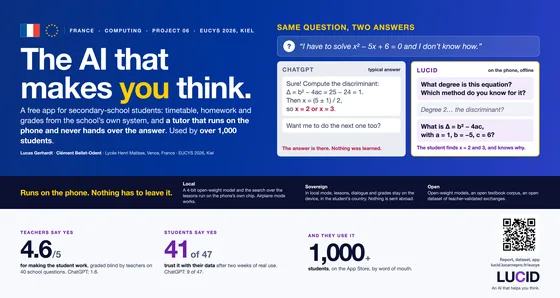
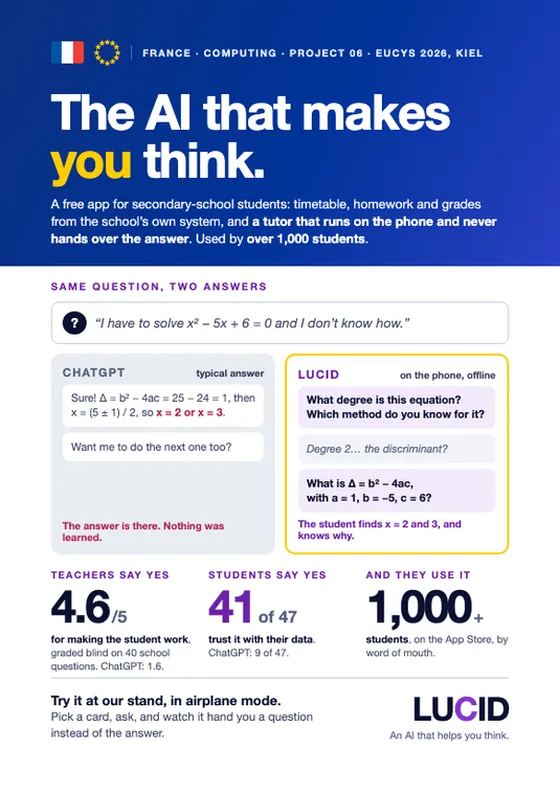
Same question, two answers: the back panel of the stand, for the public.
1,000 teacher-validated exchanges (938 “gold”), 18 subjects, 7 levels. CC BY-NC-SA 4.0.
Hugging Face8,672 chapters of open textbooks, 41 MB, prepared for search by keywords and by meaning. CC BY-SA.
Hugging FaceFree on the App Store, for iPhone and iPad. Android: soon on Google Play, a test build is on the main site. The app is in French for now.
App StoreAn EEG study from MIT (2025) measures a marked drop in brain connectivity in users of these tools, a phenomenon the researchers call “cognitive debt”. A Harvard study shows the opposite is possible: an AI configured as a tutor, brief and without revealing the solution, doubles learning gains. The decisive factor is not the power of the model, but its posture.
Can a tutor make students think, from their own lessons, on their own phone, with nothing leaving it?
Sure! Compute the discriminant: Δ = b² − 4ac = 25 − 24 = 1. Then x = (5 ± 1) / 2, so x = 2 or x = 3.
Want me to do the next one too?
The answer is there. Nothing was learned.
What degree is this equation? Which method do you know for it?
Degree 2… the discriminant?
What is Δ = b² − 4ac, with a = 1, b = −5, c = 6?
The student finds x = 2 and 3, and knows why.
4.6/ 5
for making the student work. ChatGPT: 1.6.
40 school questions, 5 subjects, graded blind by two teachers, one of them our supervising teacher.41of 47
trust it with their data. ChatGPT: 9 of 47.
Two weeks of real use, one school, self-reported.
Architecture, models, app, connectors
Evaluation protocol, field study, corpus with teachers, partnerships
Prix Lycée and Prix Orange Numérique.
Winners of the national final.
Friends of the Faculty of Engineering Innovation Award in Computer Science.
One email is enough; Lucas or Clément will answer.